
Introduction: The Color Is Made by Structure and Light
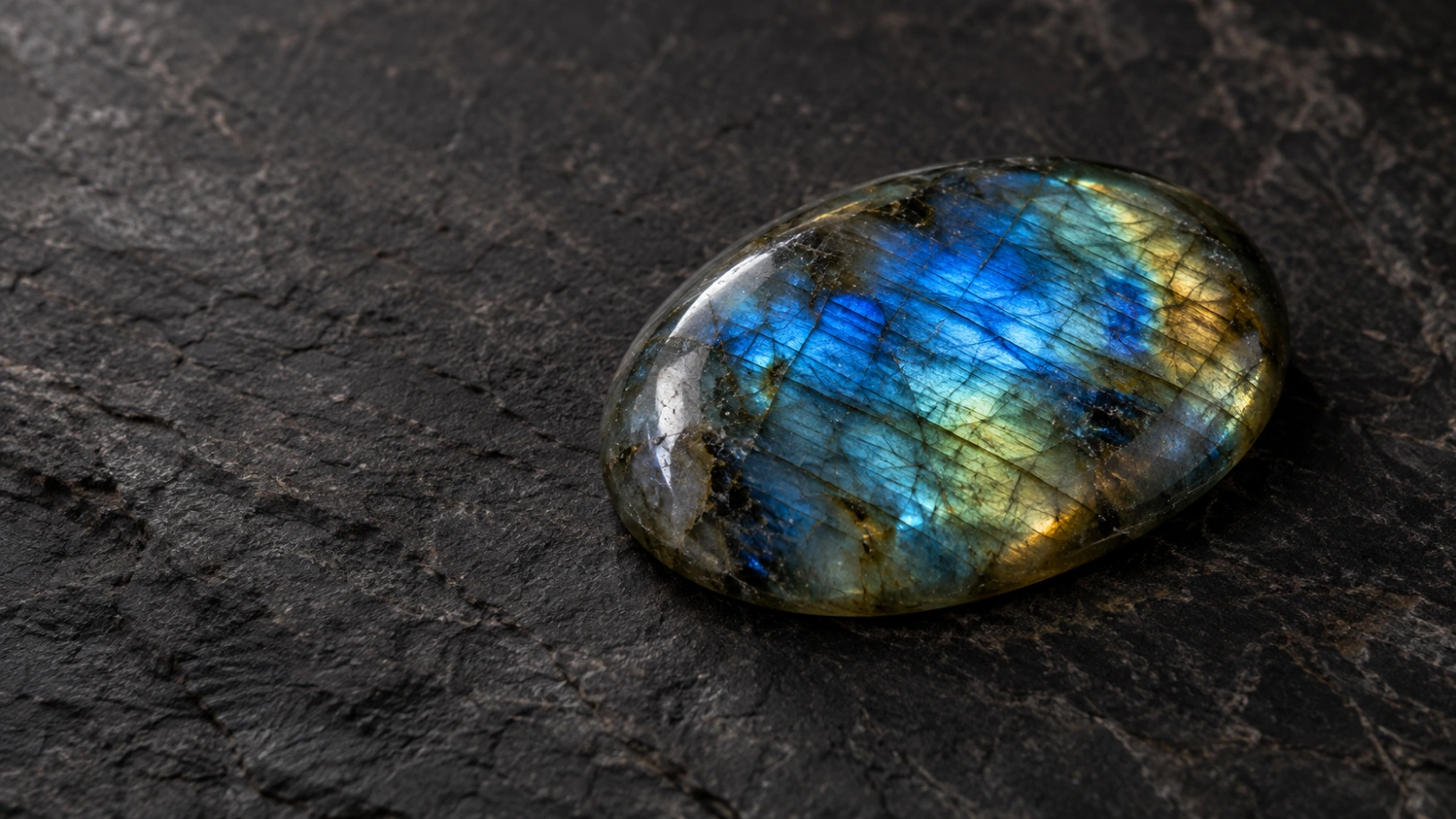
Labradorite may look gray, charcoal, brownish, or nearly black when it is resting on a table. Tilt it toward a light source, however, and a broad flash of blue, green, gold, orange, or violet may suddenly appear. This phenomenon is called labradorescence.
The flash is not ordinary body color. It is not a dye, a surface coating, or a glow produced by pigment. It is a structural optical effect created by the way light interacts with extremely thin internal layers in the feldspar.
This article focuses on the science behind that flash. It explains what the internal layers are, why the colors change when the stone moves, why some pieces show blue while others show gold or multiple colors, and why cut orientation matters.
1. What Is Labradorescence?
Labradorescence is the directional iridescent effect associated with labradorite and some related feldspar materials. It appears as a broad, shifting patch of color that seems to come from beneath the polished surface.
The term describes the optical effect, not a separate mineral species. A labradorite specimen may display strong labradorescence, weak labradorescence, or no obvious flash at all. The presence and strength of the effect depend on the internal structure, the orientation of the stone, the lighting, and the viewing angle.
It is useful to separate two visual features:
|
Feature
|
Meaning
|
|
Body color
|
The general background color of the material, which may appear gray, dark gray, brownish, greenish, or nearly black
|
|
Labradorescence
|
The directional blue, green, gold, orange, violet, or multicolor reflection that appears when light interacts with the internal layers
|
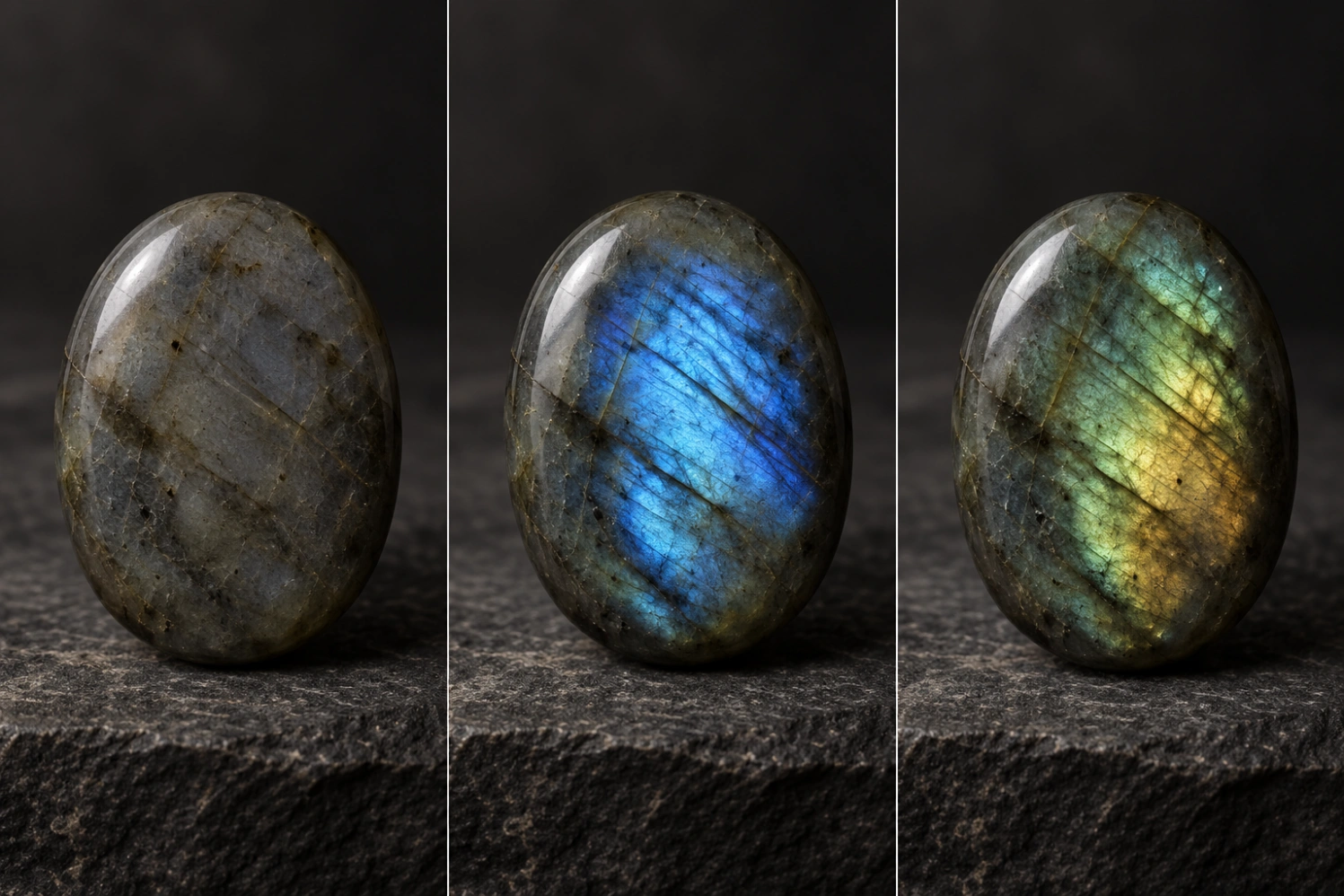
A stone can therefore have a dark body color and a bright blue flash at the same time. The background and the flash come from different optical causes.
2. The Internal Structure Begins During Cooling
Labradorite is a calcium-rich member of the plagioclase feldspar series. Its composition lies between the sodium-rich feldspar albite and the calcium-rich feldspar anorthite.
At high temperatures, different feldspar compositions can coexist within a solid solution. As the material cools, the crystal structure may no longer be able to hold those compositions uniformly. The feldspar then separates into slightly different phases. This process is called exsolution.
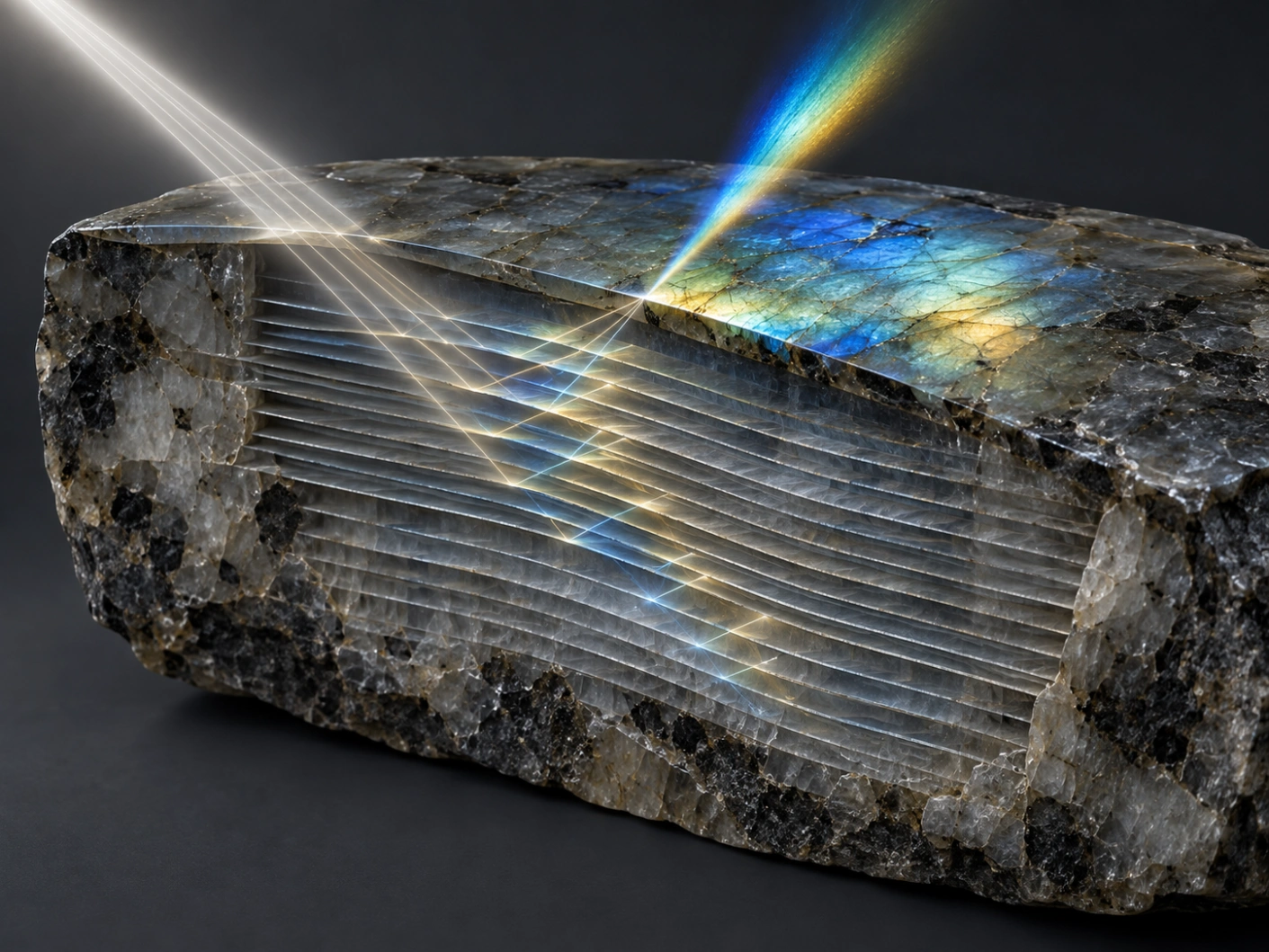
The separated phases form extremely thin, repeated internal regions called lamellae. In simple terms, these are microscopic layers with slightly different chemical compositions and optical properties. In labradorite, the layers are commonly described as albite-rich and anorthite-rich regions.
Mindat reports that the lamellar separation associated with visible labradorescence is approximately 128–252 nanometers in relevant examples. This scale is far smaller than the width of a human hair. The layers are not normally visible as separate stripes to the unaided eye. Their optical effect is visible because their size and repetition interact with visible light.
The Formation Sequence
The mechanism can be summarized as a sequence:
1.Feldspar crystallizes from a hot melt with compositions that can coexist at high temperature.
2.The crystal cools.
3.The compositions become less compatible and separate through exsolution.
4.Alternating lamellae form inside the crystal.
5.Light reflects from many internal boundaries.
6.The reflected waves interfere.
7.Certain wavelengths are reinforced and appear as a color flash.
This is why the flash is a record of both the mineral’s chemical composition and its cooling history.
3. How Do Thin Layers Create Color?
Light behaves as a wave. When light reflects from several closely spaced boundaries, the reflected waves can overlap. If the waves arrive in phase, they reinforce each other. If they arrive out of phase, they weaken or cancel each other. This is called interference.
The condition for reinforcement depends on the wavelength of light and the optical path through the layers. Visible light contains many wavelengths. The internal spacing and refractive properties of the lamellae may favor some wavelengths more strongly than others.
When blue wavelengths are reinforced toward the observer, the stone may show a blue flash. Under different structural or viewing conditions, green, gold, orange, violet, or multiple colors may be visible. The stone is not changing its chemical identity every time the color changes. The optical path is changing.
Labradorite contains many layers rather than a single film. Each boundary can contribute a small reflection. When many reflections combine in a favorable way, the result can be a narrow and intense band of reflected color. This is why a flash can look unusually pure and luminous even though each individual layer reflects only a small amount of light.
A thin soap film is a useful comparison because it also shows structural color through interference. The comparison has limits: labradorite contains a complex three-dimensional mineral structure rather than one uniform liquid film. The underlying principle is similar, but the natural crystal is more complicated.
4. Why Does the Flash Change When You Move the Stone?
Labradorescence is directional. The color depends on the relationship among three positions: the stone, the light source, and the observer.
When you tilt the stone, the angle at which light enters and leaves the lamellae changes. The optical path also changes. A wavelength that was previously reinforced may no longer be directed toward your eyes. Another wavelength may become stronger instead.
This produces three familiar effects:
•The flash appears when the angle becomes favorable.
•The flash shifts or changes color as the angle continues to change.
•The flash disappears when the reflected light is directed away from the observer.
This is why a labradorite cabochon may look quiet and gray in one photograph but vivid blue when held at a slight angle. The difference does not necessarily indicate different material or a coating. It may simply reflect different lighting geometry.
A Simple Observation Test
To observe the effect, place the stone under a bright but controlled light source. Rotate it slowly rather than moving it quickly. Watch how the color patch enters the surface, expands, narrows, shifts, and disappears. The change in appearance is part of the phenomenon, not a defect.
A phone photograph captures only one position in this changing geometry. A short video can show movement more effectively, but even a video depends on the light source and camera angle.
5. Why Are Blue and Green So Common?
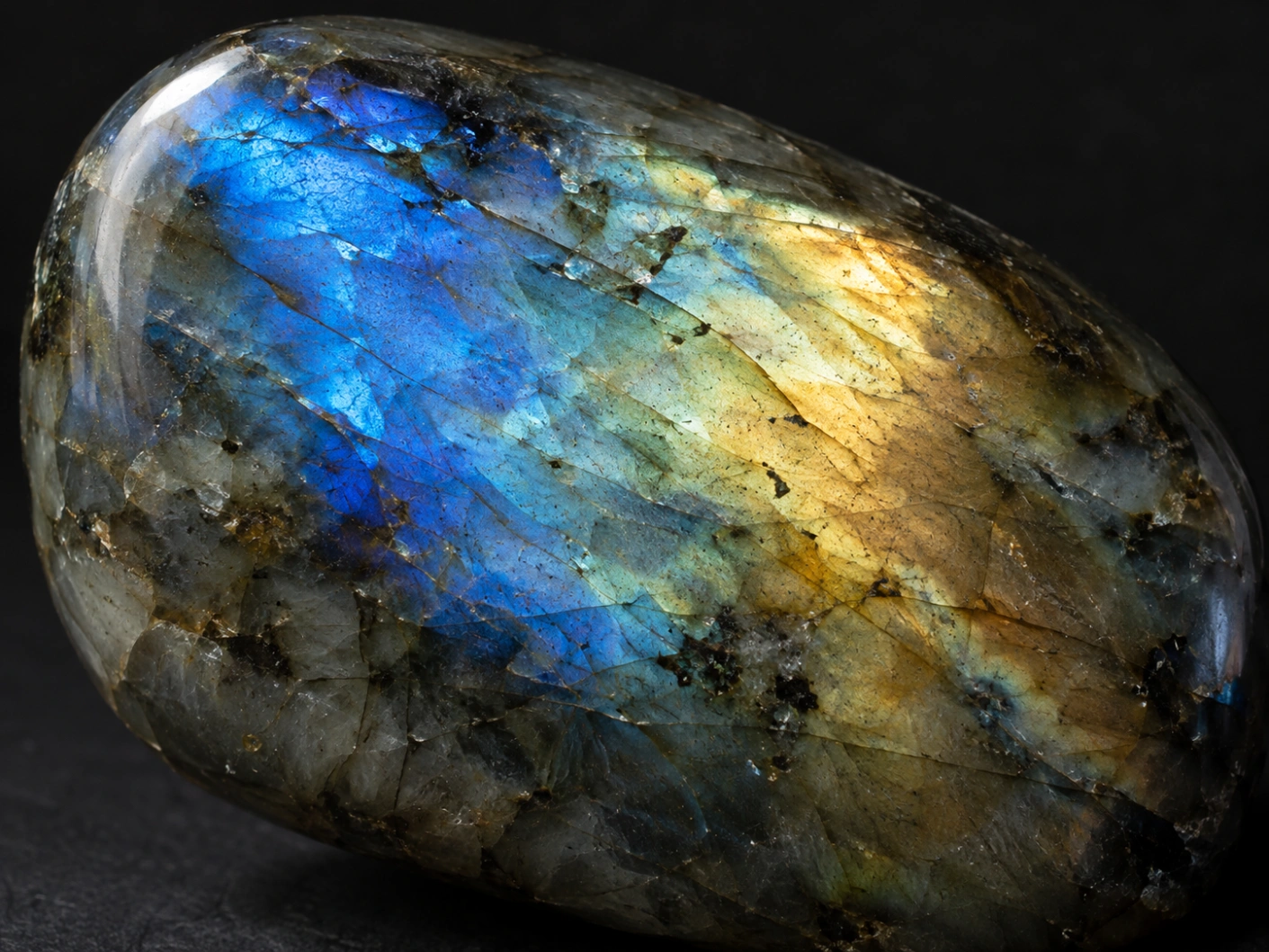
Blue and green flashes are especially familiar in labradorite. Many internal layer spacings and viewing geometries can reinforce wavelengths in these parts of the visible spectrum.
Other colors are also possible. Gold, yellow, orange, violet, and multicolor patterns can appear when the layer spacing, layer orientation, local composition, and viewing angle favor different wavelengths.
There is no simple rule that one mine or one color always corresponds to one exact layer thickness. Natural labradorite varies from one specimen to another. The lamellae can vary in spacing, orientation, continuity, and local arrangement. Different areas within the same stone may therefore show different colors.
A multicolor specimen does not contain a literal rainbow trapped inside the crystal. It contains regions whose structures reflect different parts of the visible spectrum under the current lighting geometry.
6. Why Does One Stone Flash Strongly While Another Looks Quiet?
Labradorescence is not equally developed in every piece of labradorite. A strong visual flash generally requires several conditions to work together:
1.The crystal must contain lamellae with suitable spacing and optical contrast.
2.The lamellae must be oriented so that their reflections can reach the observer.
3.The polished surface must expose the structure at a useful angle.
4.The lighting must be bright and directional enough to reveal the reflection.
5.The body color should provide enough contrast for the flash to stand out.
A stone can have beautiful internal structure but show only a narrow flash if it is cut in an unfavorable orientation. Another piece may have a smaller color range but display it across a larger portion of its face.
This is why a broad, bright blue area is not the only measure of quality. Collectors may also consider the flash’s brightness, coverage, color balance, movement, contrast, and visibility from ordinary viewing angles.
7. Why Are Labradorite Cabochons So Common?
Labradorite is often polished as a cabochon or freeform because a broad curved surface can reveal the flash across a larger area. The cutter can orient the polished face to make the strongest labradorescence visible from the front.
Faceting is possible, but many small flat facets can interrupt the broad reflection that makes labradorescence dramatic. For this optical effect, surface orientation can be more important than maximizing ordinary facet sparkle.
The ideal orientation depends on the rough material. There is no universal cutting direction that guarantees a strong flash in every specimen. Skilled cutting begins with observing the rough and locating the direction in which the color is strongest.
8. Labradorescence, Adularescence, and Iridescence: Are They the Same?
These terms describe related optical phenomena, but they are not interchangeable in every context.
Iridescence is a broad term for angle-dependent color produced by optical interference or diffraction. Labradorescence is the name commonly used for the broad color flashes of labradorite. Adularescence describes the soft, floating sheen associated most strongly with moonstone.
Both labradorescence and adularescence can involve thin internal layers and interference. Their visual appearance differs. Labradorescence is usually a more dramatic flash with stronger color contrast, while adularescence is often a softer glow that appears to move beneath the surface.
The trade name spectrolite is commonly associated with unusually vivid labradorite from Finland. “Rainbow moonstone” is a trade name often used for transparent labradorite, even though the material is not strictly the same mineral species as classic moonstone.
9. Is the Color from Pigment, Fluorescence, or a Surface Coating?
In labradorescent labradorite, the visible flash is primarily a structural optical effect. It is not ordinary pigment color. It is also not fluorescence, which is light emitted after a material absorbs higher-energy radiation such as ultraviolet light.
The flash is produced by reflected and recombined visible light. It can be bright under a flashlight or daylight because the illumination reveals the internal layer structure. When the angle changes, the reflection changes. This behavior is different from a stable surface coating that looks the same from all directions.
This distinction matters when looking at photographs. Strong saturation in an image can exaggerate the effect, while dull lighting can hide a natural flash. The most reliable impression comes from observing the actual stone as it is slowly moved under controlled light.
Final Thoughts: A Rainbow Built from Nanostructure
Labradorite’s color flash is a physical record of mineral structure. As the feldspar cooled, its compositions separated into microscopic lamellae. These layers created many internal boundaries. Light reflected from those boundaries and interfered with itself. The result is a directional flash that can appear blue, green, gold, orange, violet, or multicolored.
The flash changes because the relationship among the stone, the light, and the observer changes. Its strength depends on the layer structure, the orientation of the rough, the cut, and the lighting. A quiet gray surface can therefore become a vivid field of color without any pigment or coating being added.
At The Infinite Crystal, we see labradorite as more than a stone with a beautiful surface. Its changing color is an invitation to look more closely at the structure beneath that surface—and to see how mineral chemistry, cooling history, and light work together to create one of nature’s most distinctive optical effects.


