
Introduction: The Glow Comes from a Hidden Energy Process
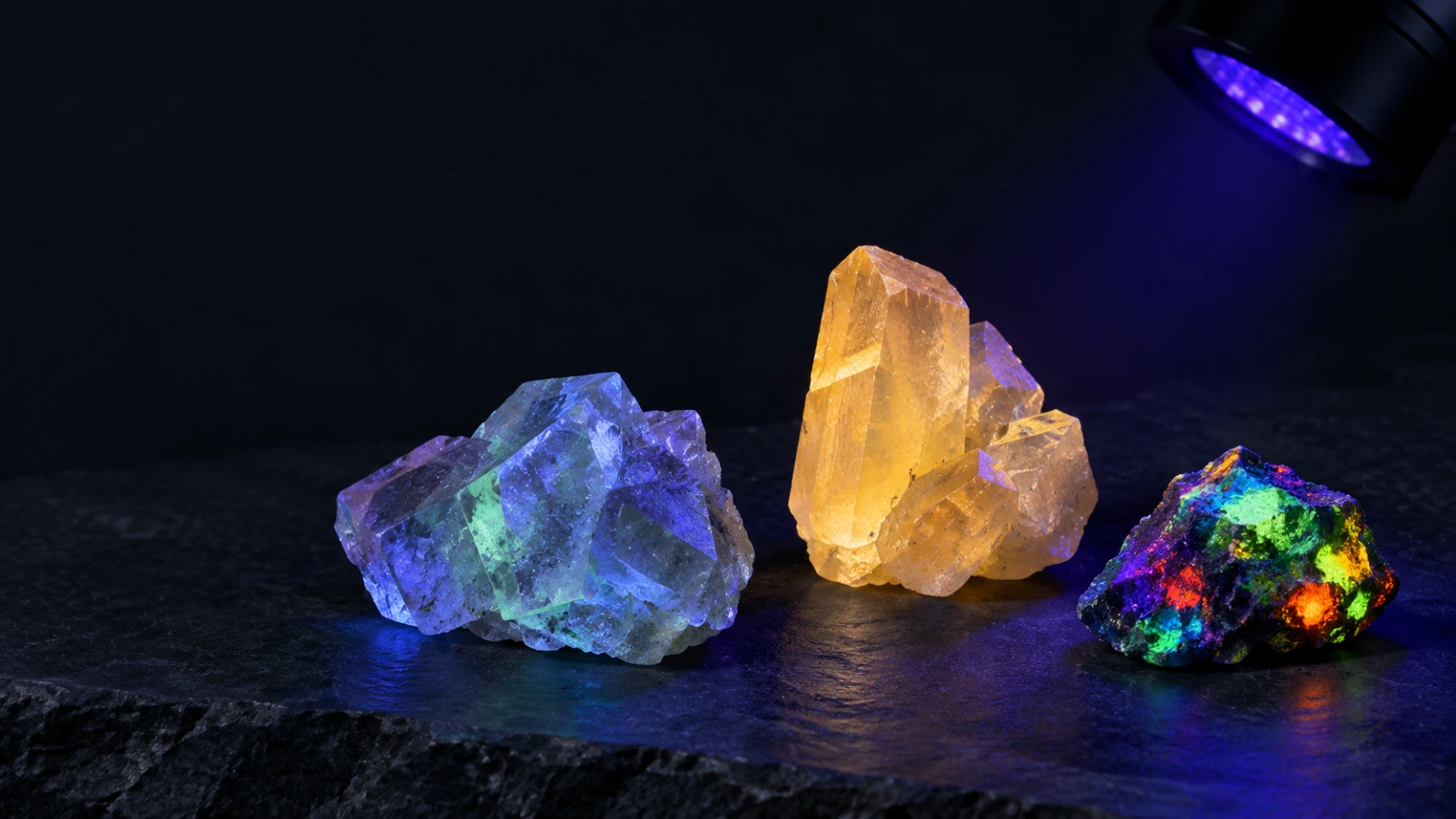
Some crystals look ordinary in daylight but suddenly shine blue, green, red, yellow, or orange under a UV lamp. This visible glow is usually called fluorescence. It is not the crystal producing light by itself, and it is not evidence of supernatural energy. It is a physical response to ultraviolet radiation.
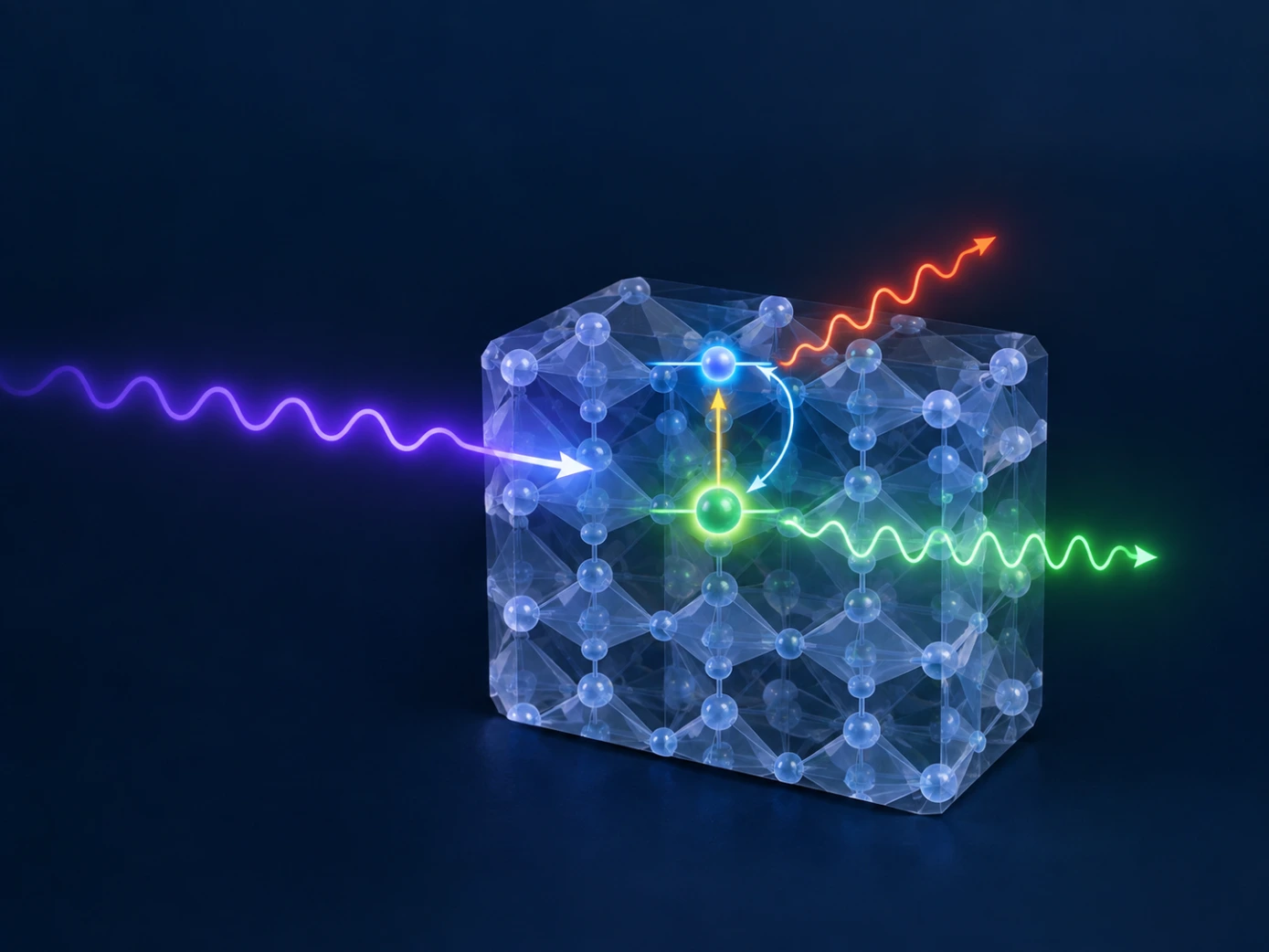
Ultraviolet light is invisible to human eyes and carries more energy than visible light. When UV enters a mineral, certain ions, defects, or structural groups can absorb that energy. Electrons in these “emission centers” move to higher energy states. As they return toward lower-energy states, some of the absorbed energy is released as visible light.
This guide focuses on the mechanism behind UV fluorescence. It explains activator ions, why two pieces of the same mineral may respond differently, how longwave and shortwave UV compare, why some crystals continue glowing after the lamp is turned off, and how to view fluorescent minerals safely.
- What Is Fluorescence?
Fluorescence is light emission that occurs while a material is being excited by an external energy source. For minerals, the energy source is often ultraviolet light.
The mineral absorbs UV photons. A photon is a packet of electromagnetic energy. The absorbed energy raises electrons associated with an ion or structural center into an excited state. The electrons do not remain there for long. They lose part of the energy as vibration or heat and then return to a lower state while emitting a new photon.
The emitted photon usually has less energy and therefore a longer wavelength than the UV photon that caused the excitation. When the emitted wavelength falls within the visible range, we see the mineral glow.
Fluorescence is usually immediate. When the UV source is removed, the visible glow generally fades almost at once because the excitation process has stopped.
- The Four Factors Behind a UV Glow
A visible glow usually requires more than simply shining a UV lamp at a crystal. Four interacting factors are important.
|
Factor |
What it means |
|
Host mineral |
The crystal structure that holds the chemical ions and controls their local environment |
|
Activator |
An ion or structural center that can absorb energy and emit visible light |
|
Excitation wavelength |
The UV band must provide energy that the activator can absorb efficiently |
|
Quenchers and defects |
Other ions, defects, or energy pathways may weaken or suppress the visible emission |
The host mineral matters because the same element can behave differently in different crystal structures. An activator is not a fluorescent “paint.” It is part of the mineral’s electronic environment, often present in very small amounts.
The quantity of an activator also matters. Too little may produce a glow too weak to see. More is not always better. At high concentrations, activator ions can interact with one another and reduce the efficiency of light emission. This is one reason fluorescence is not a simple chemical color test.
- What Are Activator Ions?
An activator is a chemical ion or structural center that helps a mineral absorb UV energy and emit visible light. Some activators are impurities that replace a small amount of a normal element in the crystal lattice. Other emission centers are part of the mineral’s own chemistry.
For example, Sterling Hill Mining Museum describes divalent manganese, written as Mn²⁺, as an activator in willemite. UV energy raises electrons associated with the manganese center. When the electrons return to lower energy states, green light is emitted.
The same educational source identifies the uranyl ion, UO₂²⁺, as an emission center responsible for the characteristic yellowish-green fluorescence of many uranium minerals. In scheelite, the tungstate group WO₄²⁻ can be intrinsic to the mineral’s fluorescence rather than an accidental trace impurity.
These examples show why mineral fluorescence has to be understood in context. A color seen under UV does not automatically identify one element. The host lattice changes the energy levels, and the final color depends on the difference between those levels.
- Why Don’t All Crystals Glow?
A mineral species can be known for fluorescence without every specimen glowing. The necessary activator may be absent, too weak, distributed unevenly, or overwhelmed by quenching elements. The crystal may also respond to a different UV wavelength than the lamp being used.
The purity of a crystal is therefore not always the reason it fails to fluoresce. In some materials, trace impurities create the glow. A nearly pure specimen may be quiet, while a specimen with the right minor element may shine brightly.
The opposite can also happen. A crystal may contain an activator but still show weak fluorescence because other defects provide pathways for the absorbed energy to dissipate as heat instead of visible light. This suppression is often described as quenching.
A useful way to think about the process is that fluorescence requires a suitable match between the crystal’s structure, its activator, its defects, and the lamp’s wavelength.
- Why Are Fluorescent Colors Different?
The color of the glow depends mainly on the energy difference between the excited state and the lower state reached during emission. A larger energy difference corresponds to a shorter emitted wavelength; a smaller difference corresponds to a longer emitted wavelength.
The host lattice shifts these energy levels. As a result, the same broad activator family may produce different colors in different minerals. The color can also vary with concentration, oxidation state, crystal chemistry, defects, and temperature.
Common examples include:
|
Mineral or material |
Possible UV response |
Important qualification |
|
Fluorite |
Often blue under longwave UV |
Not every specimen responds identically |
|
Calcite |
Many colors under longwave, midwave, or shortwave UV |
Response varies widely with impurities and locality |
|
Willemite |
Often bright green under shortwave UV |
Some specimens are also phosphorescent |
|
Scheelite |
Commonly bluish-white under shortwave UV |
Fluorescence comes from the tungstate group in the mineral |
|
Hyalite or common opal |
Often bright green under shortwave UV |
The response is commonly associated with uranyl ions in fluorescent material |
|
Ruby or red corundum |
Often red under longwave UV |
Chromium-related emission is important in many rubies, but specimen response varies |
These are examples, not guarantees. Fluorescence color should be recorded together with the mineral identity, UV wavelength, brightness, locality, and specimen history.
- Longwave, Midwave, and Shortwave UV
Mineral collectors commonly refer to three UV bands by approximate center wavelengths:
|
Collector term |
Approximate center wavelength |
General description |
|
Longwave UV or LW |
365 nm |
Nearer to visible violet; many handheld mineral lamps use this band |
|
Midwave UV or MW |
311 nm |
Intermediate wavelength; some minerals show distinctive responses |
|
Shortwave UV or SW |
254 nm |
Higher-energy UV; activates many fluorescent minerals but requires strict safety precautions |
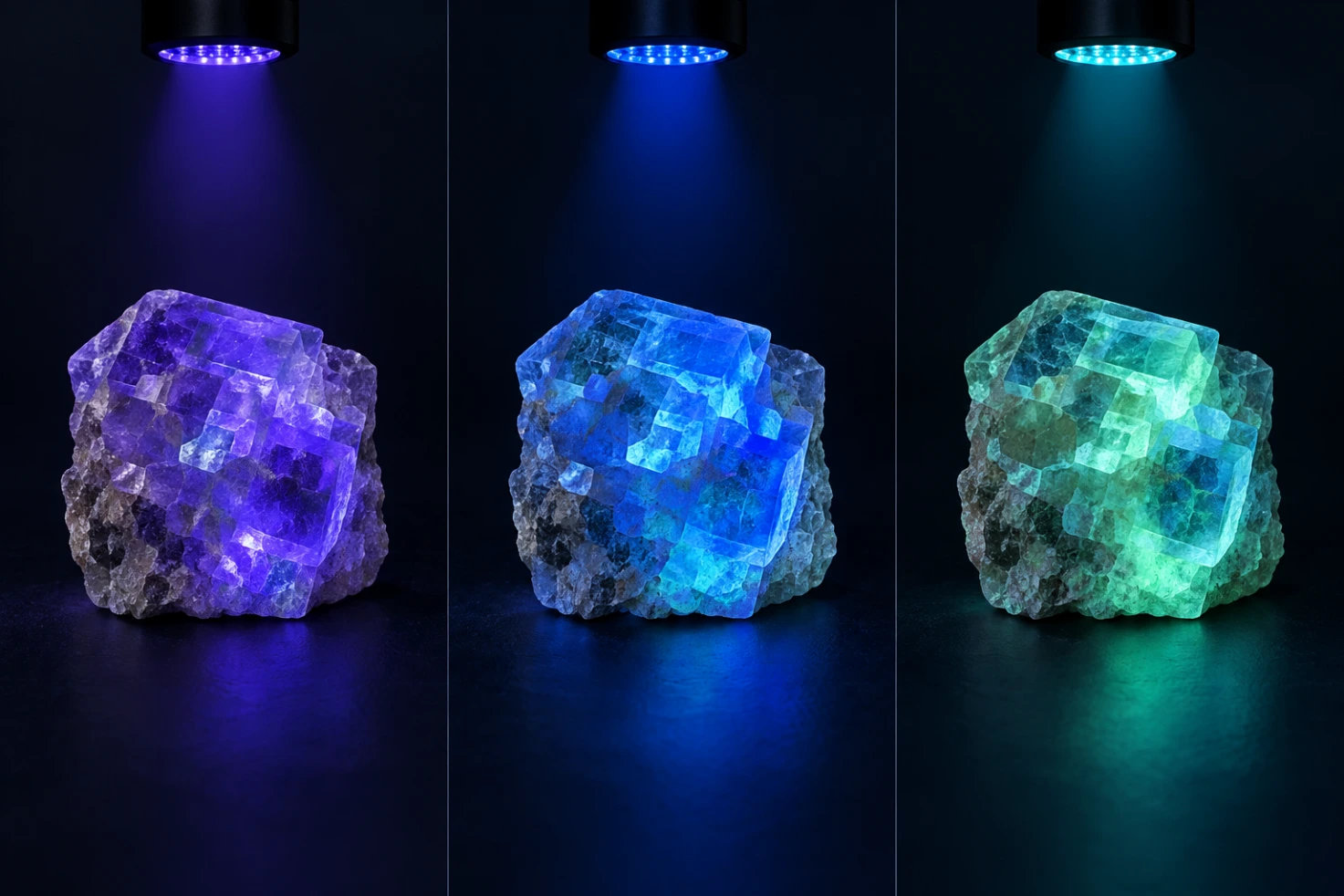
These values are practical reference points rather than a complete description of every UV lamp. A lamp’s output spectrum, filter quality, intensity, distance, and angle all affect the observation.
A mineral that is quiet under 365 nm may glow under 254 nm. Another may glow strongly under longwave but weakly under shortwave. This difference does not necessarily indicate that one lamp is defective. The activator may simply have a different absorption response.
Shortwave UV has higher photon energy and can cause delayed skin and eye burns. The Fluorescent Mineral Society advises minimizing even indirect exposure, especially when using high-power shortwave lamps.
For routine viewing, use a purpose-built mineral UV lamp with an appropriate filter and follow the manufacturer’s safety instructions. Do not look directly into a UV source or point it toward another person’s eyes or skin.
- Fluorescence vs Phosphorescence
The words fluorescence and phosphorescence describe related but different timing behaviors.
Fluorescence is the immediate emission that occurs while the UV source is active. When the source is removed, the glow usually stops almost immediately.
Phosphorescence is delayed emission. The mineral stores some excitation energy in longer-lived states and continues releasing visible light after the UV lamp is switched off. The afterglow may last for a fraction of a second, several seconds, or much longer, depending on the material and conditions.
Some specimens show both effects. A crystal may glow brightly during exposure and then retain a weaker afterglow. Others fluoresce but show no noticeable phosphorescence. A short afterglow is not proof that a mineral is more valuable or more “energetic”; it is a different luminescence behavior.
- Is the Glow the Same as Color in Daylight?
No. Daylight color and UV fluorescence come from different processes.
The visible color of a crystal in daylight is usually controlled by selective absorption, scattering, transparency, inclusions, or surface texture. UV fluorescence is produced when ultraviolet energy is absorbed and then re-emitted as visible light.
A colorless or pale mineral can fluoresce strongly. A dark mineral can also fluoresce if the emitted light is bright enough. Conversely, a colorful crystal may show no visible fluorescence at all.
This is why a UV photograph should not be treated as a replacement for normal-light identification. It is an additional observation that can reveal activators, inclusions, coatings, or differences between specimens.
- Can UV Light Prove That a Crystal Is Natural?
UV response alone is not a universal authenticity test. Natural minerals can fluoresce, synthetic materials can fluoresce, and treatments or coatings can alter fluorescence. Some natural specimens show no visible response even when their mineral species is known to fluoresce.
UV light can be useful as one part of a broader examination. A trained collector or gemologist may compare the specimen in normal light, longwave UV, midwave UV, and shortwave UV. They may also inspect its inclusions, surface, specific gravity, optical properties, and provenance.
For jewelry or a high-value gemstone, do not identify origin or treatment from fluorescence alone. Request professional testing when the distinction affects value or purchase confidence.
- How to View Fluorescent Crystals Safely
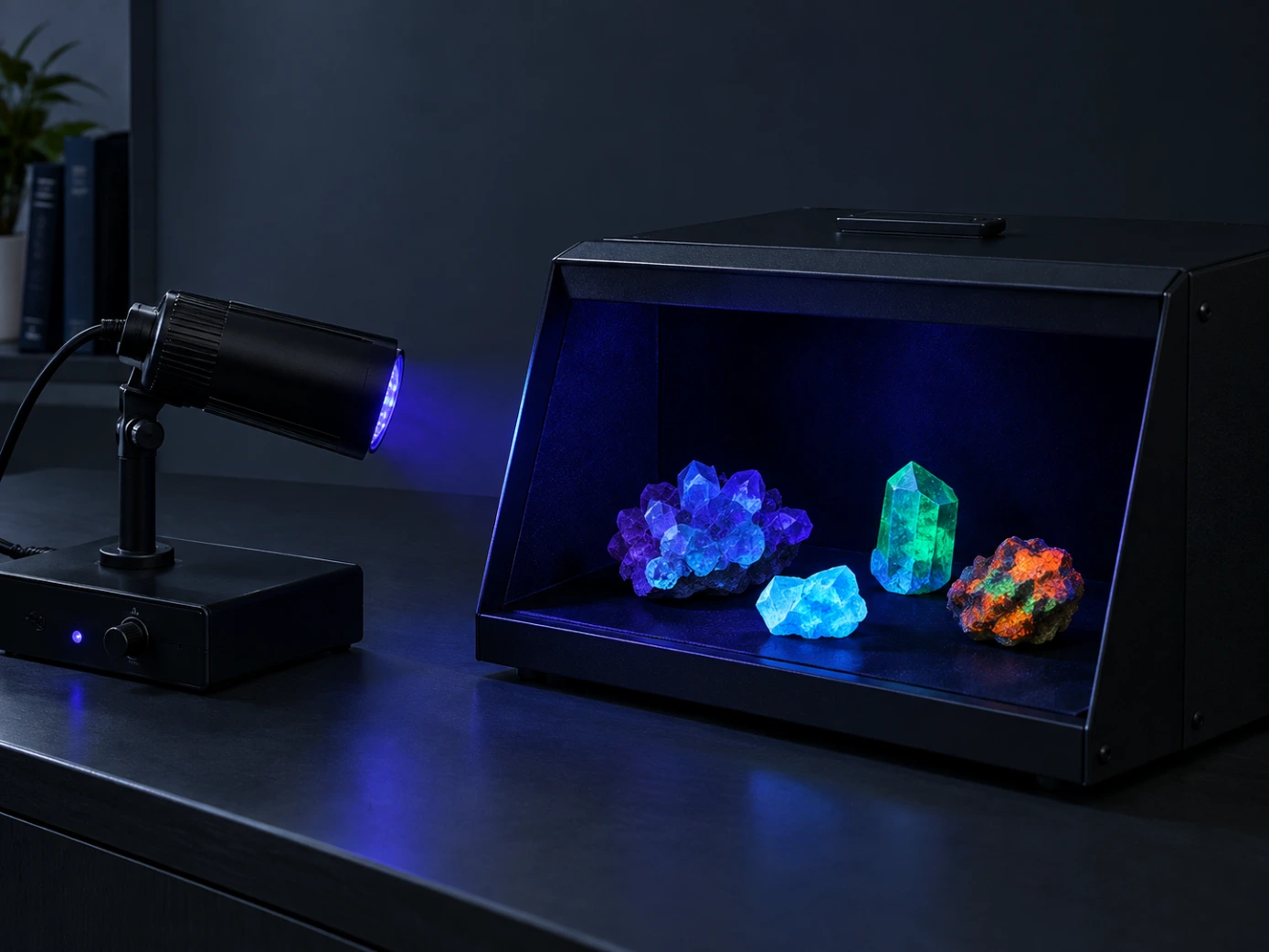
Use a darkened room so that the glow can be seen without increasing the lamp’s power unnecessarily. Place the specimen on a stable surface and keep the lamp directed at the specimen rather than at people.
Longwave UV around 365 nm is commonly used in handheld mineral lamps, but “longwave” does not mean risk-free. Avoid direct eye exposure and follow the product’s instructions.
Shortwave UV around 254 nm is more hazardous. Use proper shielding, UV-rated eye and skin protection, and equipment designed for shortwave operation. Do not use an improvised lamp or remove a protective filter. Children should only observe a shortwave setup under responsible adult supervision.
If the lamp becomes hot, produces unusual odors, has a damaged filter, or behaves unpredictably, stop using it. The mineral should be the object of observation; the UV source should never be treated like an ordinary flashlight.
Final Thoughts: A Glow Written in Crystal Chemistry
Some crystals glow under UV light because their internal chemistry provides a route for invisible ultraviolet energy to become visible light. Activator ions or intrinsic structural groups absorb UV. Electrons move into excited states. Part of the energy is released as heat, and the remainder may return as a visible photon.
The final color and brightness depend on the host crystal, the activator, the UV wavelength, defects, quenchers, concentration, and specimen history. This is why one piece of fluorite may glow brightly while another appears quiet, and why a single mineral can respond differently under longwave and shortwave lamps.
Fluorescence gives a crystal a second appearance, but it does not replace the first. Daylight reveals the mineral’s body color, transparency, form, and inclusions. UV light reveals another layer of its chemistry. At The Infinite Crystal, we believe both views can deepen appreciation for the natural structures that make every specimen distinct.


